Learn

Thermistor FAQs

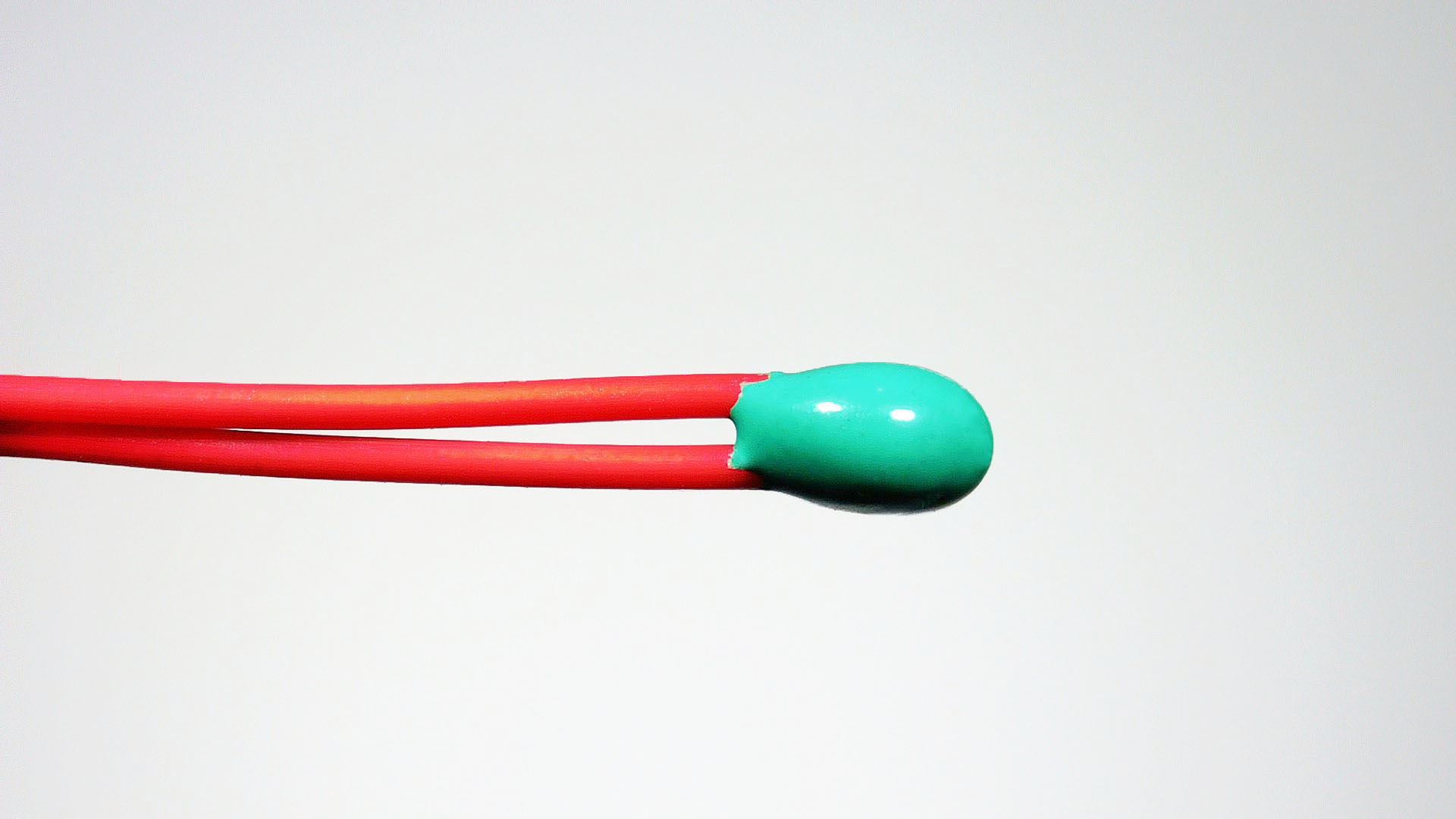
Epoxy-coated thermistor with red insulated leads

Plain-language answers for people choosing, mounting, or troubleshooting thermistors.

How thermistors work

A thermistor is a small ceramic component whose electrical resistance changes predictably with temperature. Measure the resistance, then calculate the temperature.

Where they fit

Thermistors are often a strong fit from -50 °C to +150 °C, especially when size, sensitivity, and cost matter.

How they compare

Compared with thermocouples, RTDs, and IC sensors, thermistors often offer a useful balance of sensitivity, size, response time, and cost.

Thermistors are common in modern electronics, but the vocabulary can get dense quickly. This FAQ covers the basics: what a thermistor is, where it works well, how it is mounted, how it compares to other temperature sensors, and what terms help when you are talking through an application.

For deeper technical background, see About NTC Thermistors, How to Select an NTC Thermistor, and Calculating Temperature from Resistance.

Frequently Asked Questions

  1. What is a thermistor?
    A thermistor is a small resistor whose electrical resistance changes in a predictable way as temperature changes. Measure the resistance and you can calculate the temperature of the surface, fluid, or air around the sensor. Most precision thermistors are made from metal-oxide ceramic materials.
  2. What are thermistors used for?
    Thermistors are used anywhere a small, sensitive, low-cost temperature sensor is needed: medical devices, HVAC and refrigeration, battery packs, engines, 3D printer hot ends, consumer electronics, lab instruments, and industrial equipment. They are also used for temperature compensation, where the sensor helps another circuit adjust as it warms or cools.
  3. What types of thermistors are there?

    The two electrical types are NTC and PTC. NTC thermistors decrease in resistance as temperature rises. PTC thermistors increase in resistance as temperature rises. North Star Sensors focuses on NTC thermistors for temperature measurement.

    Physically, thermistors usually come in three forms:

    • Leadless chips — small parts soldered or epoxied to a board or substrate.
    • Leaded thermistors — small ceramic sensors with two wires for PCB mounting, extension leads, or assembly into a housing.
    • Probe assemblies — a thermistor packaged in a metal or plastic tip so it can be placed on a surface, inside equipment, or in a fluid path.
  4. What are thermistors good at measuring, and what are they not?

    Thermistors are good for accurate temperature measurement over a practical mid-range, especially when the sensor needs to be small, sensitive, fast to respond, and cost-effective.

    They are not the best choice for very high temperatures, direct digital output, or applications where the sensor cannot make good thermal contact with the thing being measured. Their resistance-versus-temperature curve is non-linear, so the reading is usually converted with a lookup table, Beta equation, or Steinhart-Hart equation.

  5. Are there other sensors that do the same job?

    Yes. No temperature sensor is best for every job. The common alternatives are:

    • Thermocouples — useful across a very wide temperature range, especially at high temperatures, but usually less accurate near room temperature.
    • RTDs, such as PT100 and PT1000 sensors — accurate and stable, but usually more expensive and less sensitive than thermistors.
    • Silicon IC temperature sensors — easy to integrate and often available with a digital output, but limited by package, placement, and temperature range.

    Thermistors often win when size, sensitivity, response time, and cost all matter in the -50 °C to +150 °C range.

  6. How are thermistors mounted or attached?

    It depends on the package:

    • Leadless chips are soldered or conductive-epoxied to a circuit board or hybrid substrate.
    • Leaded thermistors can be soldered into a PCB, connected to extension wires, or potted into an assembly with epoxy.
    • Probe assemblies can be attached with threaded fittings, clips, adhesive pads, thermal grease, or inserted into a thermowell, duct, or fluid path.

    The attachment method matters, but thermal contact matters more. The sensor has to be close enough to the real temperature you care about.

  7. What are the parts of a typical temperature-measuring system?

    A common signal chain includes:

    1. Sensor element — the thermistor bead or chip.
    2. Leads or cable — often twisted-pair or shielded when noise matters.
    3. Connector — the interface between the probe and instrument.
    4. Signal conditioning — often a voltage divider with a reference resistor, sometimes with filtering or amplification.
    5. ADC — an analog-to-digital converter that turns voltage into a number.
    6. Microcontroller or instrument — converts resistance to temperature using the thermistor's R/T curve.
    7. Display, logger, or control output — shows the reading, records it, or uses it to control a heater, fan, valve, or alarm.
  8. What terms should I know when talking about thermistors?

    A few terms come up often:

    • Resistance and Ohm's Law — the basics of turning a thermistor signal into a measurable voltage.
    • R25 — the thermistor's resistance at 25 °C.
    • R/T curve — the relationship between resistance and temperature.
    • Beta value and Steinhart-Hart equation — common ways to convert resistance into temperature.
    • Self-heating — heat created by measurement current through the thermistor.
    • Tolerance and interchangeability — how closely one part or lot matches the specified curve.
    • Thermal time constant — how quickly the sensor responds to a temperature change.
  9. What is the difference between NTC and PTC thermistors?
    NTC stands for Negative Temperature Coefficient. An NTC thermistor decreases in resistance as it gets hotter, which makes it useful for precision temperature measurement. PTC stands for Positive Temperature Coefficient. A PTC thermistor increases in resistance as it gets hotter and is often used for resettable fuses, current limiting, or self-regulating heaters. North Star Sensors manufactures NTC thermistors.